On 16 June 2026, Accountability Watch Afghanistan (AWA) launched the Human Rights Violation Documentation Portal for documenting alleged human rights violations and abuses in Afghanistan. The portal is available in English and local languages, including Farsi-Dari, Pashto and Uzbek.
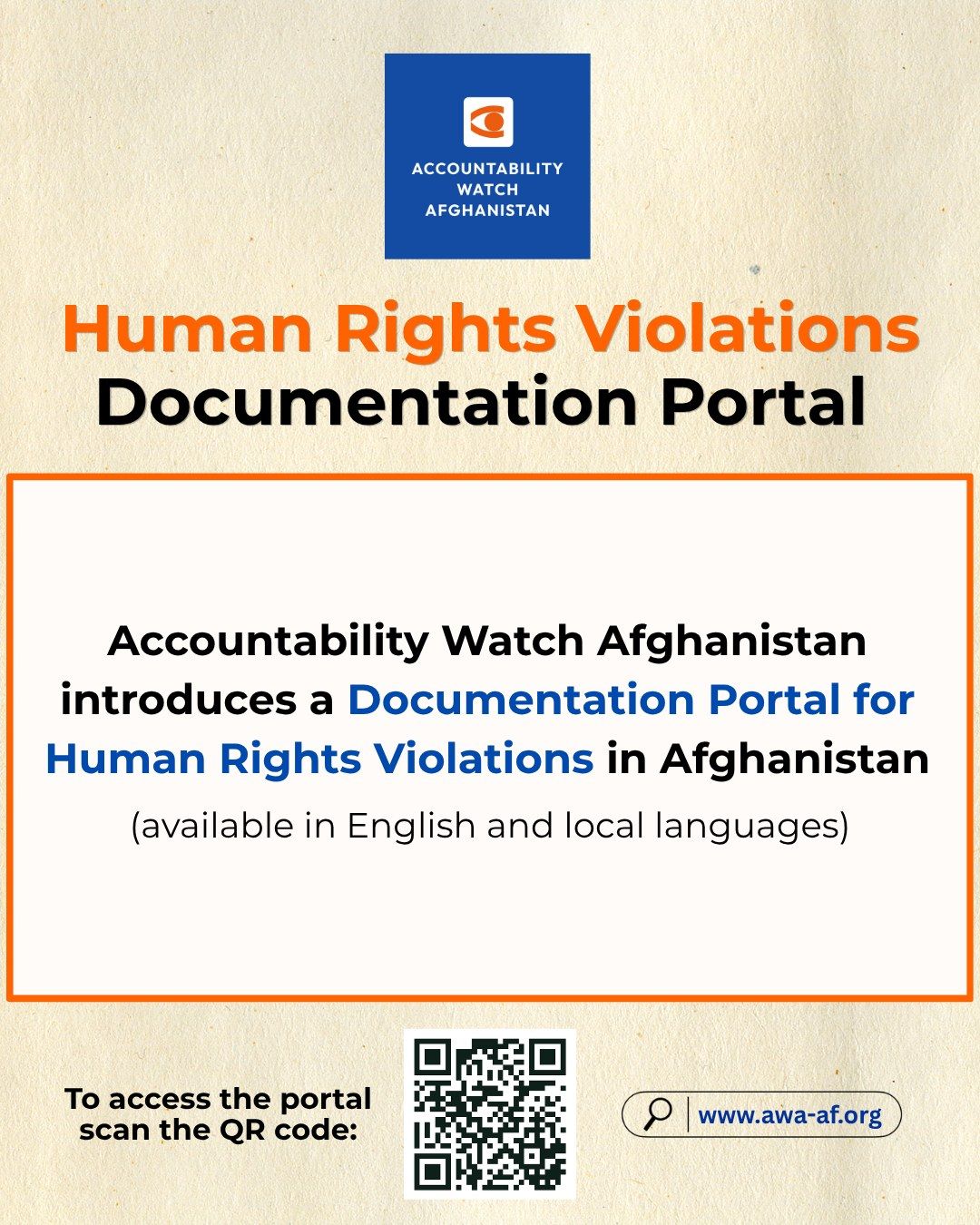
This platform is created to provide an opportunity for individuals and communities to submit information, testimonies, documentation, and other materials that may serve as evidence of alleged human rights violations and abuses in Afghanistan.
Purpose
This initiative is part of AWA's broader human rights monitoring and documentation efforts, which include a close observation of developments, information collection, verification, research, analysis, and preservation of evidence.
The portal provides a safe and accessible mechanism for individuals, communities, and organizations to submit information and materials concerning alleged human rights violations in Afghanistan.
Objective
The primary objective of the portal is to develop a tailored response to the increasing restrictions on access to information and ongoing reprisals in Afghanistan by providing a secure mechanism for information sharing.
This initiative aims to collect, analyze and transform individual reports of violations and relevant testimonies into credible and evidence-based documentation that can support research, public reporting, advocacy initiatives, accountability efforts, and, where possible, engagement with relevant national and international human rights mechanisms for further investigations.
Through this portal and systematic documentation, AWA seeks to preserve records of violations and abuses, strengthen accountability processes, support potential investigations, and contribute to the protection and promotion of human rights in the medium and long term.
Review process
Secure receipt
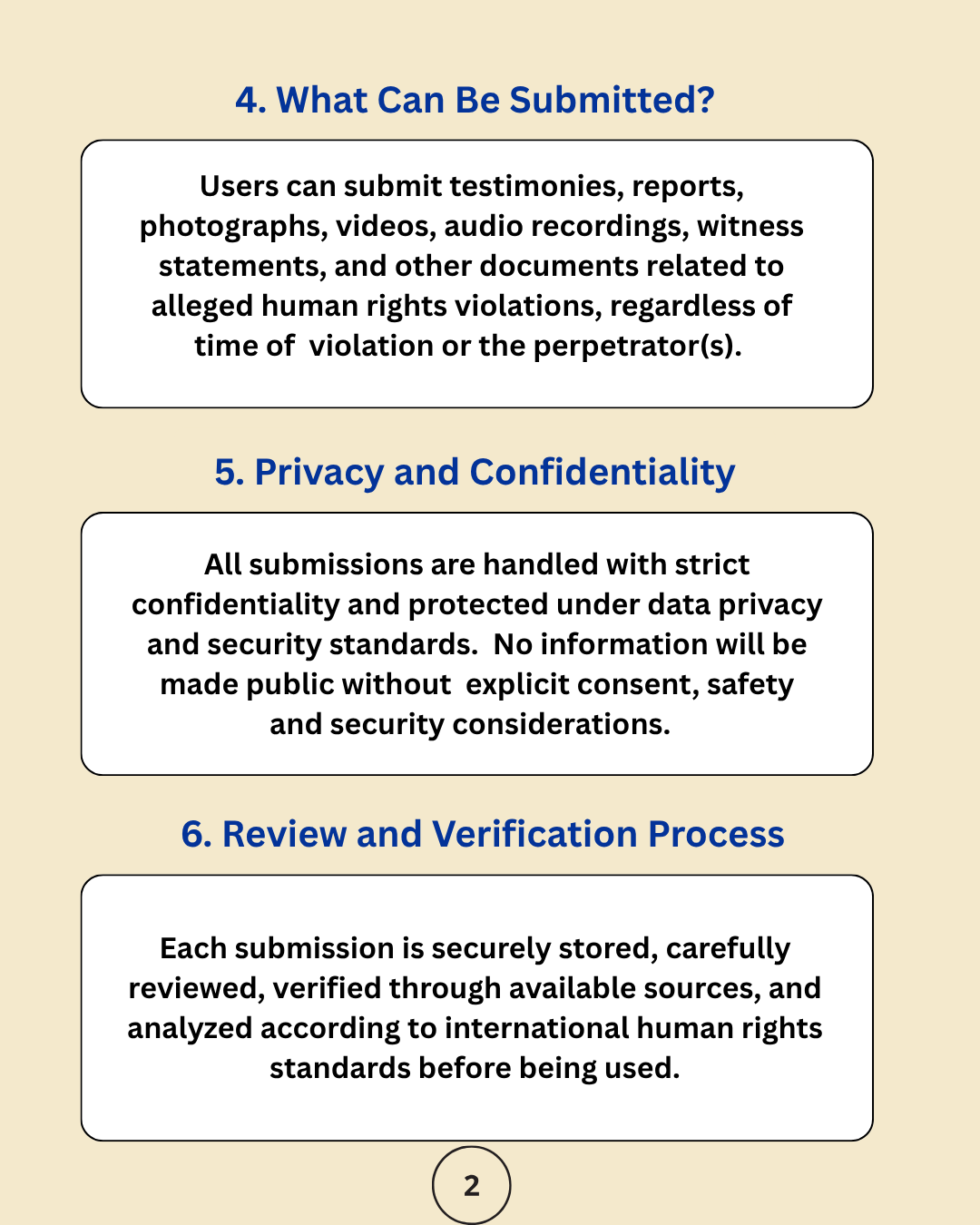
Information submitted through the portal will be securely saved, and managed in accordance with data protection law, privacy policy, security and confidentiality protocols.
Assessment
Once received, submissions are assessed to find their relevance, completeness, and potential evidentiary value.
Verification
A thorough verification process, including cross-referencing other available information, is conducted to establish all facts about the case.
Analysis
A comprehensive analysis, in line with international standards, is conducted to identify patterns, trends and recurring forms of rights violations and abuses.
The portal at a glance
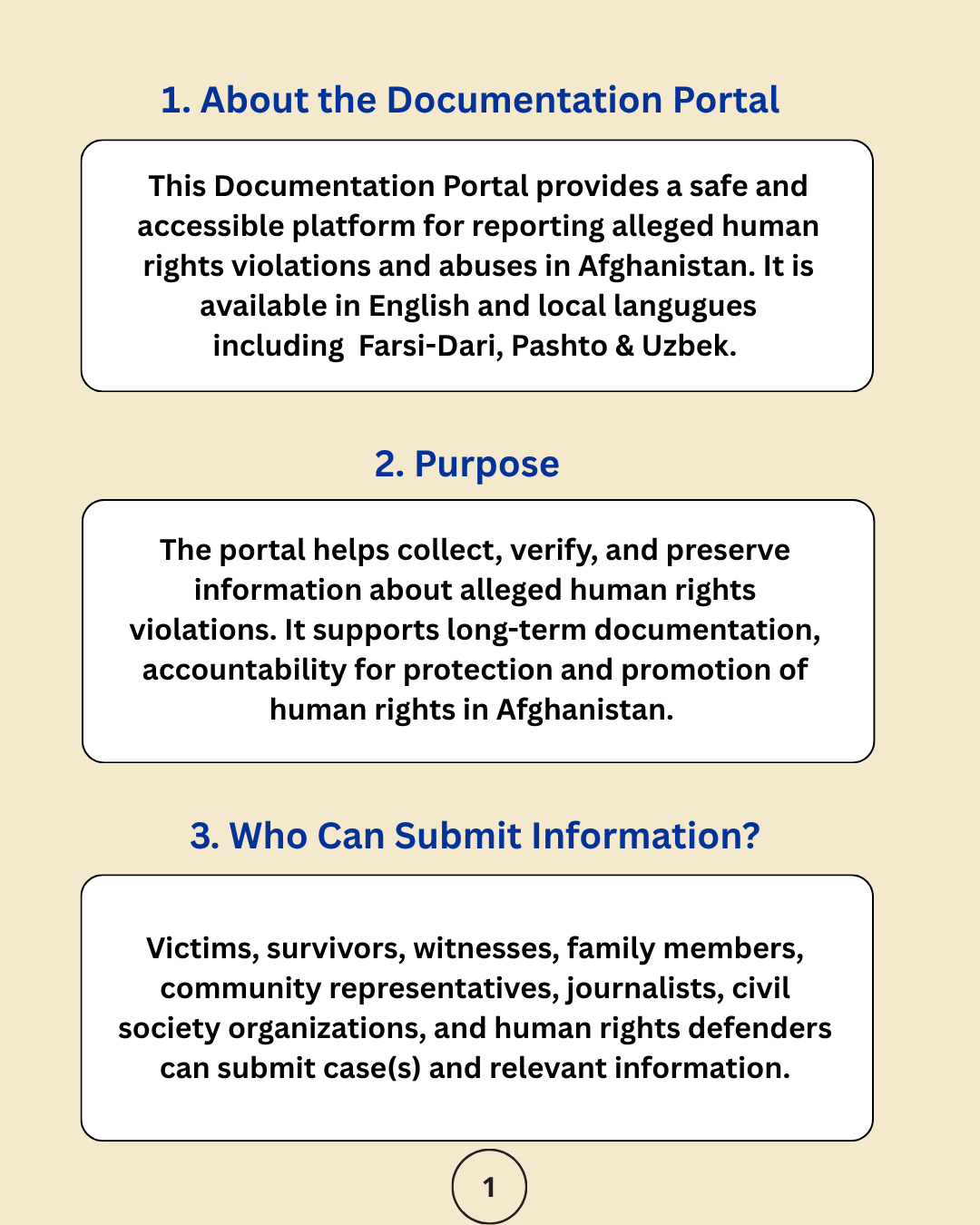
The panels below summarise this explainer in a form that can be shared and printed. Select a panel to open it at full size, or download all four as a single poster.
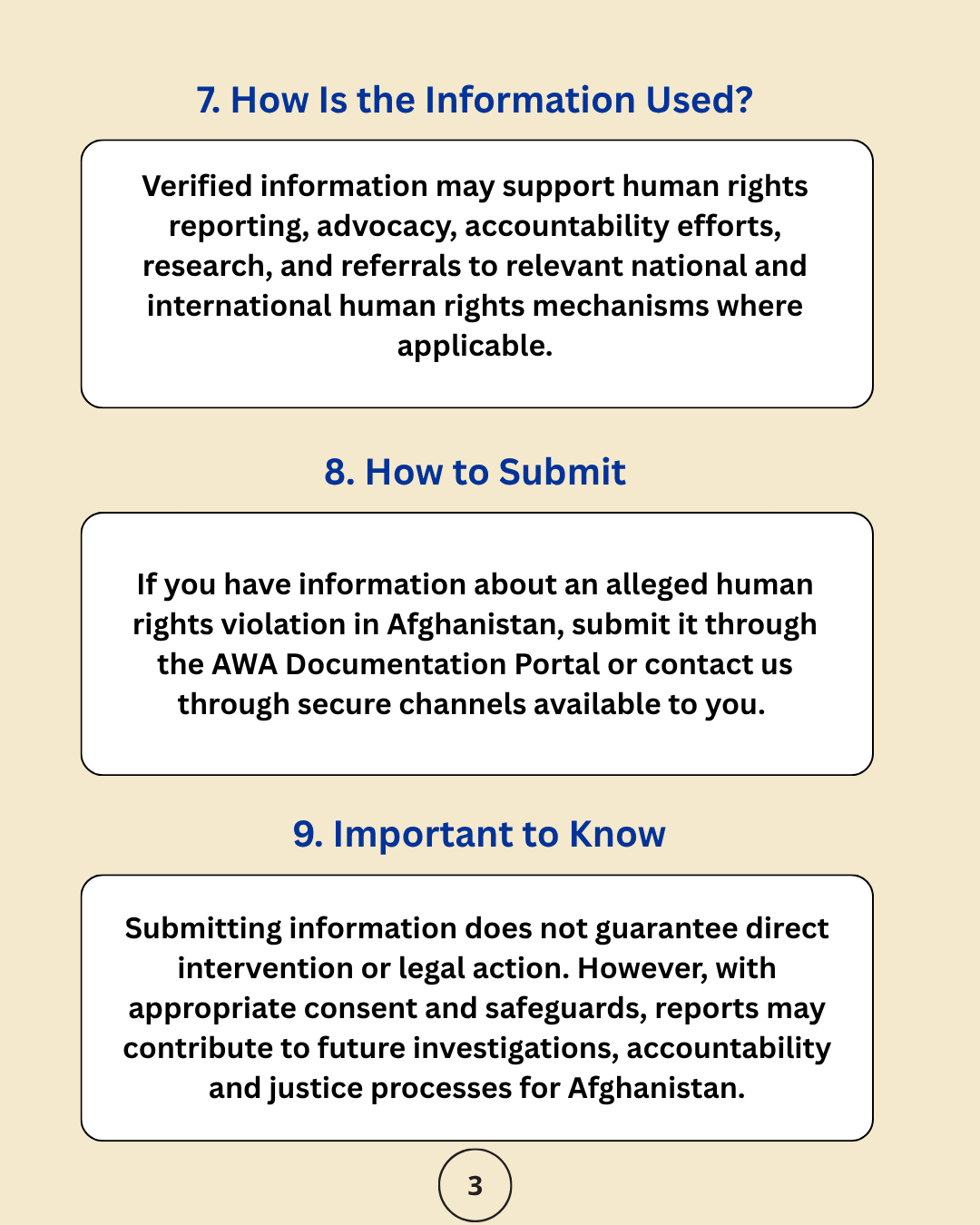
Share the poster
All four panels, including the cover with the QR code for the portal, in one file for printing and sharing.
Download the poster (PDF)
Use of information and follow-up actions
Any use of the information will be consistent with informed consent, confidentiality requirements, and protection principles. The information collected may be used to inform human rights reports, advocacy initiatives, early warning efforts, and submissions to relevant national, regional, and international human rights mechanisms. Documented information may also contribute to accountability processes, fact-finding initiatives, legal analysis, or future investigations conducted by competent bodies such as the International Criminal Court.
AWA may contact individuals who make submissions to seek clarification, additional documentation, or updates where doing so is considered safe, necessary, and consistent with the principles of informed consent and “do no harm.” This communication is for documentation and verification purposes only.
Case submission does not imply, and should not be understood as, direct assistance, operational intervention, or guaranteed action by AWA or any third party.
Questions and answers about the documentation portal
- 1. Who can submit information through the portal?
- Submissions can be made by victims, survivors, witnesses, family members, community representatives, civil society organizations, journalists, and human rights defenders.
- 2. What types of information can be submitted?
- Submissions may include information or materials regarding alleged human rights violations or abuses, including incidents affecting individuals or communities, regardless of the time and perpetrator of the violations or abuses. They can also include supporting documents, photographs, videos, audio recordings, witness statements, and other relevant materials that may serve as evidence.
- 3. Can I submit information anonymously?
- Yes, you may choose not to provide identifying information. However, providing contact information may enable follow-up communication if additional clarification or information is required.
- 4. Is my information kept confidential?
- Yes, all submissions are handled with strict attention to confidentiality, security, and protection considerations. Information is stored and processed in accordance with applicable privacy and data protection requirements.
- 5. Will my information be shared publicly?
- No, information submitted through the portal will not be made public without appropriate consideration of confidentiality, security, consent, and protection concerns. Where appropriate, information may be shared with trusted third parties in accordance with these safeguards and the purpose of the submission.
- 6. What happens after I submit a report?
- Submitted information is reviewed and assessed by the documentation team. Cases are verified, analyzed, and used for documentation, reporting, advocacy, accountability, and, where appropriate, referrals to relevant national and international human rights mechanisms. Any sharing of information is guided by due diligence, data minimization, and confidentiality principles. Only information that is necessary and relevant for the intended purpose is shared, and appropriate safeguards are applied to protect the security and privacy of individuals. Information is shared only with institutions that have appropriate protection measures and a legitimate mandate to receive it. Personal data is regularly reviewed to ensure its continued relevance and accuracy and is updated or securely deleted when it is no longer necessary for documentation or accountability purposes.
- 7. Can I update information after submitting a report?
- Yes, if you have additional information or wish to correct previously submitted information, you may submit an update and reference your earlier submission where possible.
- 8. Can I request access to, correction of, or deletion of my personal information?
- Subject to applicable privacy and data protection laws, individuals may request access to, correction of, or deletion of personal information and related materials they have submitted.
- 9. Does submitting information guarantee an investigation or legal action?
- No, submission of information does not automatically result in an investigation, legal proceedings, or other action. However, where applicable and with explicit consent, cases can be referred to relevant human rights bodies for potential interventions, investigations and protection.
- 10. Who operates the portal?
- The portal is operated by Accountability Watch Afghanistan (AWA) as part of its efforts to document alleged human rights violations and abuses in Afghanistan and to support accountability, transitional and restorative justice, peace and security in Afghanistan.
Submit information
If you have information regarding an alleged human rights violation or abuse in Afghanistan, you can submit it through the Human Rights Violations Documentation Portal. Victims, survivors, affected person(s), witnesses, family members, community representatives, journalists, human rights defenders, and organizations are encouraged to submit relevant information, testimonies, and supporting evidence.
Email: info@awa-af.org
WhatsApp / Signal: +1 672-336-5725